
Security has been a constant throughout Richard Ross’s career, ever since he joined the Army as a teenager. Today, as Founder and Managing Director of Ubique Risk Management, he brings decades of experience and a deep understanding of the industry to an award-winning business.
From building Ubique to developing and delivering the Accredited Healthcare Security Management Specialist (AHSMS) qualification, Richard continues to put his knowledge into practice, helping shape the future of security management.
In this article, Richard reflects on his journey into the industry, shares his perspective on the latest developments in security, and reveals what life looks like away from work.
I suppose my journey into security began at 17 when I joined the British Army’s Royal Engineers. In truth, it probably started even earlier through the Army Cadets. Back then, security awareness was simply a part of life. The UK was still facing the threat of terrorism from the IRA, and it wasn’t uncommon to be conscious of the risks associated with wearing military uniform while travelling to and from cadet activities. As strange as that may sound today, it was the reality at the time and it certainly shaped my awareness of security from a young age.
Joining the Army reinforced that mindset. From day one, discipline, vigilance, resilience and service were embedded into everything we did. Throughout my military career, I was stationed in both the UK and Germany, as well as undertaking a range of overseas operational deployments. Working in environments where threats were real and security was never something you could take for granted instilled a security culture that has remained with me throughout my entire career.
After leaving the Army, I established and ran a security systems company, designing and installing CCTV, intruder alarm and access control systems. That gave me a strong technical grounding and helped me understand how security technology contributes to the protection of people, property and assets as part of a wider security strategy.
At the same time, I was also working here and there for my father-in-law’s security company as a door supervisor and security officer, covering a wide range of venues, events and security assignments. Those front-line roles taught me a great deal about dealing with people, managing conflict, assessing risk and making decisions under pressure. They also confirmed something I had already begun to realise, that I genuinely enjoyed working within the security profession.
Following a particularly positive experience on a training course, one of the instructors suggested I should consider becoming a trainer myself. Having previously worked as an instructor in the Army and thoroughly enjoyed developing others, it felt like a natural progression. I gained the necessary civilian qualifications and started delivering security training in 2003, something I continue to this day.
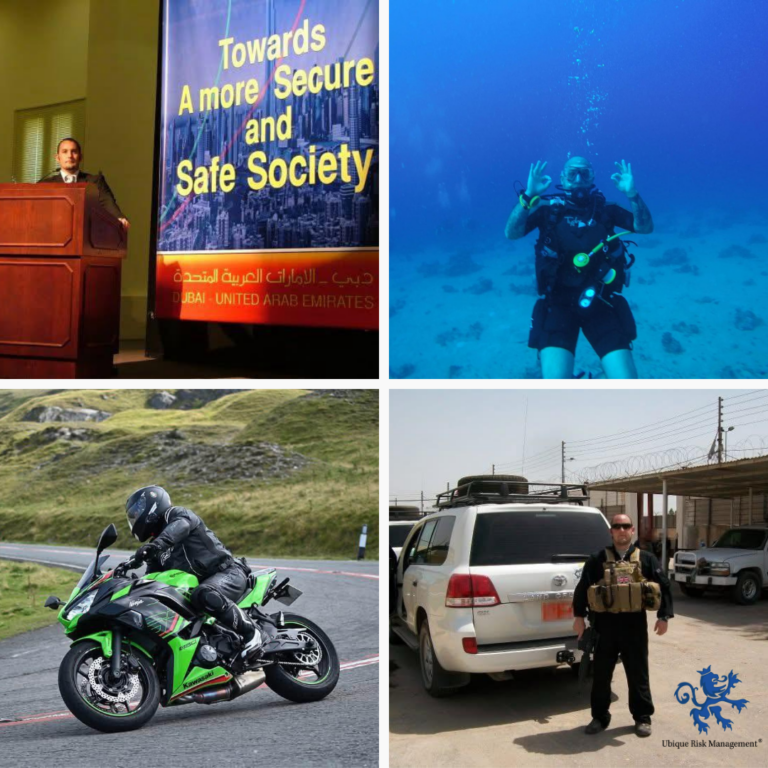
Over the years, I have delivered training across a broad range of disciplines, including security officer training, door supervision, close protection, CCTV operations, cash and valuables in transit, conflict management, physical intervention, maritime anti-piracy operations, sea survival, security awareness and security management. One particularly memorable chapter of my career was working with the Dubai Police Academy, delivering security management programmes. It was a privilege to help develop security professionals in such a prestigious environment and it broadened my understanding of security from both operational and leadership perspectives.
My career then took me into the maritime sector, where I worked on anti-piracy operations protecting commercial vessels transiting high-risk waters. At the time, the threat from piracy and armed attack was very real, and the role demanded a combination of planning, professionalism and operational discipline.
From there, I progressed further into close protection, working with high-profile celebrities, affluent businesspeople and foreign royalty before moving into hostile environments, including Libya during the uprising, various locations in Iraq, and other high-risk countries. These roles involved protecting clients operating in some of the world’s most challenging and unstable environments and provided invaluable experience in risk management and protective security.
As my career continued to evolve, I became increasingly involved in mentoring and developing others before moving into consultancy. Following my time in Iraq, I secured what I often jokingly refer to as my first “big boy job” as a Local Security Management Specialist within the NHS. Based in London, I was responsible for supporting a number of NHS Trusts, each with their own complex security challenges. From there, I moved into the nuclear sector, where I have spent the last 14 years specialising in protective security, risk management and critical national infrastructure protection.
Today, as Managing Director of Ubique Risk Management, I draw upon more than three decades of experience spanning military service, security technology, front-line guarding, training, close protection, maritime security, consultancy and strategic security leadership.
Looking back, I have been fortunate enough to experience security from almost every angle. From installing security systems and working the doors of venues, to protecting clients in hostile environments, safeguarding vessels at sea, developing future security professionals and advising organisations on complex security challenges. That breadth of experience allows me to provide practical, proportionate advice based on real-world experience rather than theory alone, and that’s something I believe clients genuinely value.
Ubique Risk Management was actually my third business since leaving the Army. I originally established it as a vehicle through which I could undertake consultancy work when the opportunity arose while I worked within the NHS. What started out as a practical business mechanism quickly evolved into something bigger.
As my experience grew across sectors such as healthcare, critical national infrastructure, and the nuclear industry, it became increasingly clear that the market lacked security advice that was both practical and grounded in real-world experience, delivered by genuine people who deliver excellence with integrity. Too often, organisations are sold expensive solutions they don’t need, or they’re left trying to navigate complex security challenges without the right support and guidance or are being sold service by snake oil salesmen.
I wanted to build a consultancy that did things differently. One that combined operational experience with professional expertise and focused on delivering honest, proportionate and achievable solutions. Security should enable organisations to operate safely and confidently, not burden them with unnecessary complexity.
Today, Ubique Risk Management is built around that same principle: helping clients understand their risks, make informed decisions and implement security measures that genuinely improve their resilience. Everything we do is underpinned by real-world experience, practical thinking and a commitment to delivering solutions that work in the real world, not just on paper.
The threat landscape is constantly evolving. Organisations today face a wide range of challenges, from terrorism and hostile acts through to cyber threats, insider risks and vulnerabilities within increasingly complex supply chains. Technology is advancing rapidly, threats are becoming more sophisticated, and organisations are expected to remain resilient whilst continuing to operate efficiently.
One of the biggest challenges is finding the right balance between security and business operations. Security measures must be effective, but they also need to be practical, proportionate and workable for the people who use them. The most effective security arrangements are those that become part of the organisation’s culture rather than something that is seen as an obstacle.
However, if I am pressed to identify the single greatest security challenge facing organisations today, my answer is always the same: the insider threat.
In my view, the insider threat is both the most realistic and the most difficult threat to manage. Organisations naturally focus on external threats, yet the people who already have legitimate access to facilities, information, systems and processes often represent the greatest risk. Whether through malicious intent, coercion, negligence or simply poor judgement, insiders can bypass many of the security measures designed to keep external threats out.
It is a subject I have a particular interest in and one that I explored in depth during my Master’s Degree in Terrorism and Security, where I focused my dissertation on insider threats. Over the years, I have continued to study the topic and its implications for organisations operating across critical sectors. I have also been invited to provide expert commentary for ITV News on a high-profile insider threat case, which highlighted just how significant and often misunderstood this risk can be.
The reality is that whilst organisations can invest heavily in fences, CCTV, access control and cybersecurity, the insider threat remains one of the most challenging risks to detect, understand and mitigate. That’s why creating a strong security culture, conducting effective vetting, promoting staff engagement and establishing robust reporting mechanisms are just as important as any physical or technical security measure. Ultimately, security is about people, and so are many of the risks.
Martyn’s Law is changing the way organisations think about public safety, security and preparedness. For many businesses, it means taking a more structured approach to understanding terrorist threats, training staff, assessing vulnerabilities and planning how they would respond should the unthinkable happen. Whilst it places additional responsibilities on organisations, the fundamental aim is to create a stronger culture of awareness, preparedness and resilience. Ultimately, it is about helping organisations better protect their staff, customers and visitors.
For those of us working in protective security and counter-terrorism consultancy, the introduction of Martyn’s Law has been a long time coming. Personally, I have been following its development since the early discussions that eventually led to the legislation. For many years, I and many others within the industry have been advising clients that measures of this nature were likely to become a legislative requirement, encouraging them to adopt many of the principles well before the law came into force.
It was clear to me from an early stage that there was sufficient public, political and industry support behind the initiative for it to become a reality. As a result, many of our clients in the public realm (local authorities) have been preparing for some time, developing their security arrangements, training programmes and emergency response plans in anticipation of the legislation.
Whilst the final version may not be as far-reaching as some security professionals would have liked, I believe it represents a significant step forward. For the first time, there is a clear expectation that organisations should actively consider the threat of terrorism and take proportionate steps to prepare for it, rather than simply hoping it will never affect them.
Like any major piece of legislation, its true effectiveness will only become apparent over time. There is still work to be done by government, regulators, security professionals and organisations themselves. However, in my opinion, Martyn’s Law is a positive development that will help embed a culture of preparedness across the UK and ultimately improve the safety and resilience of our public spaces.
That’s a difficult question because I’ve been fortunate enough to work on some incredible projects throughout my career, both in the UK and internationally. If I had to choose, I would say I’m most proud of what my team and I have built through Ubique Risk Management and the impact we’ve been able to have across a wide range of sectors.
I often say that we’re a small company that punches well above its weight, and I’m proud that we’ve consistently proven that to be true. Our reputation has been built on delivering high-quality work, developing trusted client relationships and providing practical solutions to complex security challenges. Everything we’ve achieved has come through hard work, expertise and a genuine commitment to helping our clients succeed, building trust, and developing genuine relationships.
Over the years, we’ve had the privilege of supporting some truly significant projects. Internationally, we’ve partnered with organisations such as the World Institute for Nuclear Security (WINS), working alongside nuclear regulatory bodies and industry stakeholders in Thailand, Malaysia and South Africa. Closer to home, we’ve worked directly with the Office for Nuclear Regulation (ONR), designing and delivering the UK’s Civil Nuclear Security Practitioner training programmes, helping to develop the competency of security professionals responsible for protecting some of the country’s most critical assets.
We’ve also worked extensively with the National Skills Academy for Nuclear, delivering specialist training across the nuclear fuel cycle and supporting operators, site licence companies and their supply chains. Alongside this, we’ve provided consultancy and advisory services to organisations within the nuclear sector, healthcare, local government and defence, helping them strengthen their security, resilience and compliance in an increasingly complex threat environment.
More recently, one project that I am particularly proud of has been the development and delivery of the Accredited Healthcare Security Management Specialist (AHSMS) Level 5 programme. Having spent part of my career within the NHS, I understand first-hand the unique security challenges faced by healthcare organisations. Seeing the programme develop from an idea into an accredited qualification that is helping healthcare security professionals enhance their knowledge, skills and career progression has been immensely rewarding. Knowing that it is contributing to improved security standards across healthcare settings and ultimately helping to protect staff, patients and visitors makes it a project I am especially passionate about.
Some of the work I’m proudest of is often the least visible. Over the years, we’ve contributed to government-led initiatives designed to strengthen the protection of UK critical infrastructure and improve resilience against emerging threats, including hostile state activity and acts of sabotage. Whilst much of this work remains behind the scenes, knowing that our expertise has contributed, even in a small way, to protecting essential services and national interests is incredibly rewarding.
More than any individual project, however, I’m proud of the reputation we’ve built and the trust our clients place in us. Seeing the team grow, watching individuals develop their careers, and knowing that the work we do helps protect people, organisations and critical services is what gives me the greatest sense of achievement. When I look back at how far we’ve come, it’s not any single contract or project that stands out; it’s the collective impact we’ve had and the fact that a relatively small company from Wales has been able to make a meaningful contribution on both a national and international stage.
One of the things I enjoy most about working in security is that no two days are ever the same. One day you might be conducting a security risk assessment for an office; the next, helping to design protective security measures for a top-secret critical national infrastructure site, delivering specialist training, or advising senior leaders on complex security challenges. The variety keeps things interesting, but more importantly, I enjoy helping people solve problems and giving organisations the confidence that they are better prepared to deal with threats and uncertainty.
What has always attracted me to security is the sheer breadth of the profession. It is such a vast sector with so many different specialisms and opportunities to learn. That’s one of the reasons I have accumulated such a wide range of qualifications and experiences throughout my career. Whenever I found an area of security that interested me, I wanted to understand it properly, gain experience in it and develop my expertise. From physical security and security technology to close protection, maritime security, training, consultancy and strategic risk management, I’ve genuinely enjoyed exploring the many different facets of the profession.
What also keeps me engaged is that every organisation is different. The challenges faced by a nuclear facility are very different to those faced by a hospital, a local authority, a public venue or a government department. Even within the same sector, no two organisations have identical risks, priorities or operating environments.
Perhaps most importantly, security is rarely static. We live in a constantly changing world where threats, vulnerabilities and geopolitical factors evolve all the time. As new technologies emerge and adversaries adapt their methods, the security measures needed to protect organisations must evolve as well. It’s a profession that continually challenges you to learn, adapt and stay ahead of the curve.
That combination of variety, complexity and continuous learning is what I enjoy most. It keeps us on our toes, and after more than 30 years in the industry, I’m still learning something new. That’s what makes security such a fascinating profession to be part of.
Be curious and never stop learning. Security is an incredibly broad profession with countless specialisms and career paths, so take every opportunity to gain experience, develop your knowledge and learn from those around you. Focus on understanding risk rather than simply applying security measures, and always remember that good security should enable organisations to operate safely and effectively, not create unnecessary barriers.
One piece of advice I often give is to build as many strings to your bow as possible. The wider your knowledge, skills and experience, the more opportunities will present themselves throughout your career. That approach has served me well. Throughout my career, I’ve always looked for opportunities to learn something new, gain a new qualification or broaden my experience in a different area of the profession. Security is far too interesting, and far too diverse, to limit yourself to just one specialism.
I’d also encourage people to work hard, be honest and protect their integrity at all costs. Your reputation is one of the most valuable assets you’ll ever have in this industry. People remember those they can trust, and trust takes years to build but moments to lose.
Networking is equally important. Get out there, attend industry events, join professional bodies, meet people and build genuine relationships. Like many industries, opportunities often arise through the people you know and the reputation you build. Sometimes that introduction or recommendation can be the lucky break that opens a door. However, once you’re through that door, you still need the knowledge, competence and professionalism to succeed.
One thing I would strongly advise against is trying to bluff your way through situations. If you don’t know something, be honest about it. Nobody knows everything, particularly in a profession as broad and fast-moving as security. If there’s a gap in your knowledge, acknowledge it, then go away and learn. People generally respect honesty far more than misplaced confidence.
Finally, understand your strengths, recognise your areas for development and own both. None of us are perfect, and the moment you think you’ve learned everything is the moment you stop growing. The best security professionals I know are the ones who remain humble, continue learning and are constantly looking for ways to improve.
I’ve been in the profession for more than 30 years and I’m still learning. That’s one of the reasons I enjoy it so much. Security is constantly evolving, and if you embrace that mindset of continuous improvement, you’ll never stop finding new opportunities to develop both personally and professionally.
Outside of work, my biggest passion used to be scuba diving. I was fortunate enough to dive in some incredible locations around the world and absolutely loved everything about it. There’s something quite special about being underwater; it’s a completely different environment where the normal pressures and distractions of daily life simply disappear. Unfortunately, due to health reasons, I eventually had to give it up, which was a difficult decision as it had been such a significant part of my life for many years.
On the positive side, it has given me more time to focus on other interests and spend more time with family and friends. I enjoy getting out on my motorcycle whenever I can, as there’s nothing quite like the freedom of being out on the open road. More recently, I’ve also taken up golf. I say “taken up” rather than “mastered”, as it’s very much still a work in progress! Like many people who start the game, I’ve discovered that it’s far more challenging than it looks, but that’s part of the appeal.
I also enjoy reading and keeping up to date with developments in security, risk management and current affairs. Security isn’t just a job for me; it’s a subject I’ve been passionate about for more than 30 years. Even when I’m not working, I often find myself reading about emerging threats, new technologies or changes in the geopolitical landscape that may influence the way organisations think about security in the future.
Ultimately, though, my favourite way to spend time away from work is simply being with my family. After a career that has taken me to some unusual places and involved a fair amount of travel, I’ve learned to appreciate the value of spending quality time with the people who matter most.


We use cookies to enable essential functionality on our website, and analyze website traffic. By clicking Accept you consent to our use of cookies. Read about how we use cookies.